Jan van Stinemolen's 1582 Naples: Nature, Fortifications & Artistic Truth
Miguel Fernández ·
Listen to this article~4 min
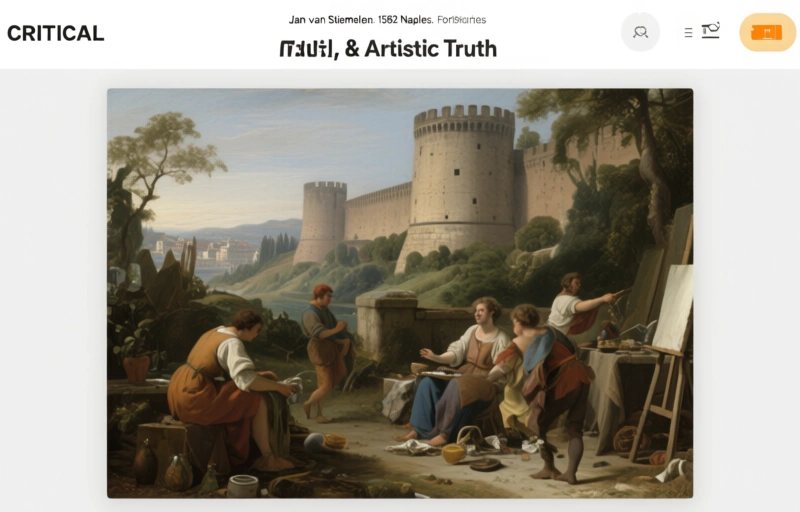
Explore Jan van Stinemolen's unique 1582 view of Naples. This analysis delves into its unusual perspective, puzzling fortifications, and how it reveals a growing Renaissance interest in nature and volcanic landscapes.
Let's talk about a map that makes you look twice. Back in 1582, artist Jan van Stinemolen didn't just draw another picture of Naples. He did something different. While most maps of the time were flat and focused on streets, Stinemolen climbed up the hillside. He looked down towards the gulf. This simple shift in perspective changed everything.
Suddenly, you don't just see a city. You see Naples living within its dramatic landscape. You feel the looming presence of Mount Vesuvius. You sense the sprawling Phlegraean Fields. Nature isn't just a backdrop here—it's the main character, both outside and woven right into the city walls.
### The Puzzle of the City Walls
Now, here's where it gets interesting for anyone studying urban history. Stinemolen's drawing shows the city's fortifications in a way that doesn't quite match the official records. We know Viceroy Pedro de Toledo built a specific defensive circuit. But Stinemolen's version? The form is different. The connection to the northwestern neighborhoods doesn't line up.
Scholars have debated this for ages. Is it a mistake? A creative liberty? The question of topographical truth in this drawing is a big deal.
### A Gate That Shouldn't Be There
Let's zoom in on one specific oddity. Stinemolen draws a huge, monumental gate facing the viewer. It's grand and oddly fashioned. The catch? Historical sources say that spot only had a minor opening back then, a little passage locals called a *pertuso*. The actual grand gate for that area, the Porta Medina, wasn't built until about sixty years *later*.
So why draw it? This might not be an error. It could be intentional. Stinemolen might have been tapping into the imagery of ancient, classical towns. By adding this anachronistic gate, he could be suggesting Naples's deep, timeless roots, connecting it visually to the old Roman world.
### Reading the Bedrock: A Naturalist's Eye
Perhaps the most fascinating layer is how Stinemolen treats the land itself. He pays incredible attention to the bedrock—the very foundation the city is built upon. You can see its relevance and visual variation in his lines. This wasn't a one-off. Other drawings by him show the same focus.
This emphasis on natural phenomena, especially the volcanic landscape unique to Naples, is telling. It places Stinemolen right in the middle of a growing intellectual movement. In the late 16th century, a naturalist curiosity about volcanoes was exploding. Scholars were starting to observe, describe, and truly study these forces of nature.
Stinemolen's view does more than map a city. It participates in that narrative. His drawing parallels the scholarly stories emerging at the time. He wasn't just an artist; he was an observer, using his pen to highlight the powerful dialogue between human settlement and the raw, untamed earth.
So, what can we learn from this 440-year-old view?
- **Context is everything:** Seeing a city within its full environment reveals deeper truths.
- **Artistic license has purpose:** "Inaccuracies" can be deliberate statements about history, legacy, and identity.
- **Art and science meet:** The drawing is a historical document *and* a piece of naturalist observation.
In the end, Stinemolen gives us more than a map. He gives us a perspective. He reminds us that to understand a place, you have to see its bones—the rock it stands on—and the stories its people, and its artists, choose to tell.