Jan van Stinemolen's 1582 Naples View: Nature and City Walls
Miguel Fernández ·
Listen to this article~4 min
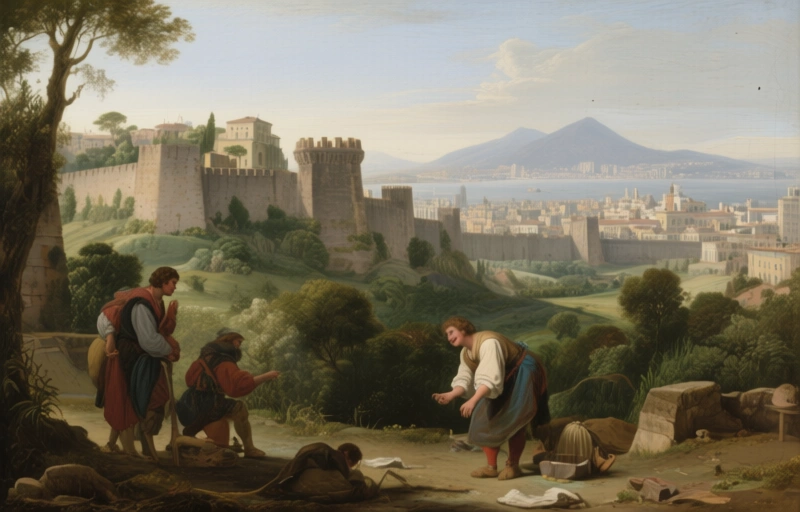
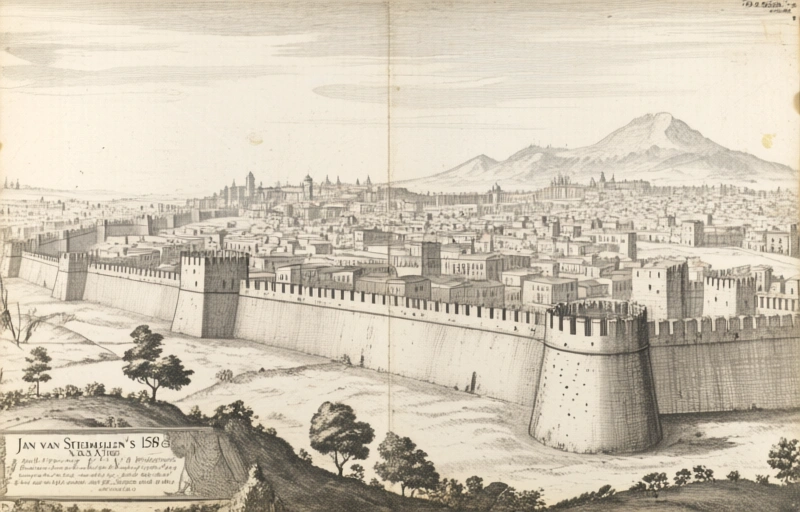
Jan van Stinemolen's 1582 view of Naples offers a unique hillside perspective, blending the city with its volcanic landscape. His depiction of walls and a grand gate challenges historical records, suggesting intentional symbolism of antiquity, while his focus on bedrock reveals a naturalist's eye.
Let's talk about a map that makes you see Naples differently. Back in 1582, artist Jan van Stinemolen didn't just draw another city plan. He climbed up the hillside and looked down toward the gulf. That simple shift in perspective changed everything.
You suddenly see Naples not as an isolated fortress, but as a city nestled within a vast, dramatic landscape. Vesuvius looms in the distance, and the Phlegraean Fields stretch out. Nature isn't just a backdrop here; it feels like the main character, weaving its way both outside and inside the city's defensive walls.
### The Mystery of the City Walls
Now, here's where things get interesting for anyone studying urban history. Stinemolen's drawing shows fortifications that don't quite match the official records. We know Viceroy Pedro de Toledo built a specific circuit of walls. But Stinemolen's version looks different in both form and how it connects to the northwestern neighborhoods.
Scholars have debated this for ages. Is it an error? A creative liberty? The truth might be more intentional than we think.
### An Intentional Anachronism?
Take the monumental gate facing the viewer. It's grand and oddly fashioned. Historical sources tell us that at that exact site, there was only a minor opening called a *pertuso*. The actual grand gate, Porta Medina, wasn't built until about sixty years later.
So why did Stinemolen draw it? It might not be a mistake. This feature, and others like it, closely match the popular imagery of ancient, classical towns. He might have been deliberately evoking a sense of timeless antiquity, painting Naples as a city with deep, legendary roots.
### Reading the Bedrock: A Naturalist's Eye
Perhaps the most compelling layer is how Stinemolen treats the land itself. He pays extraordinary attention to the bedrock—the very foundation of the city. You can see its relevance and visual variation across his work.
This wasn't just artistic detail. It paralleled a growing intellectual movement of the time. Naturalists were becoming fascinated with volcanic phenomena, and the Neapolitan region was a living laboratory. Stinemolen's emphasis on the rocky terrain suggests he was part of this conversation, using his art to document and highlight these unique natural forces.
- **Unusual Perspective:** Surveying from hill to gulf, embedding the city in its environment.
- **Architectural Puzzles:** Walls and gates that challenge historical records.
- **Symbolic Intent:** Features that may deliberately reference ancient urban imagery.
- **Naturalist Document:** A focus on bedrock and geology reflecting contemporary scientific interest.
As one scholar noted, "The drawing asks us to look beyond topography to see the stories a city tells about itself and its place in the world."
In the end, Stinemolen's view is more than a map. It's a layered document. It's a statement about how a city interacts with its natural setting. It's a possible commentary on its perceived ancient heritage. And it's a snapshot of a moment when art and early science began to look at the world with fresh, curious eyes. For professionals analyzing urban form, it reminds us that every depiction carries a point of view, and sometimes the 'inaccuracies' are where the real truth lies.