Jan van Stinemolen's 1582 Naples Panorama: A New Perspective
Miguel Fernández ·
Listen to this article~4 min
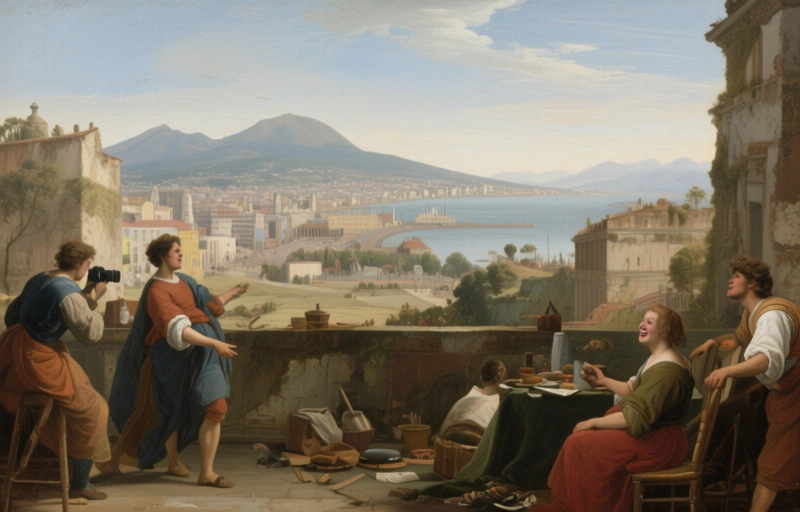
Discover Jan van Stinemolen's 1582 Naples panorama, drawn from the mainland instead of the bay. New research reveals this overlooked masterpiece as sophisticated art, not just simple topography.
Back in 1582, a Dutch artist named Jan van Stinemolen did something pretty remarkable. He finished a massive panorama of Naples, but here's the twist – he didn't draw it from the usual spot overlooking the bay. Instead, he showed us the city from the mainland side, looking back from the hills. It's a perspective shift that makes you see Naples in a whole new light.
This ink-on-paper masterpiece now lives in Vienna's Albertina museum, but honestly? It hasn't gotten nearly enough attention. Sure, scholars who study Neapolitan geography know about it, and so do experts in Dutch drawing. But there hasn't been that deep dive into what makes this work so special. That's finally changing.
### Why This Drawing Matters More Than You'd Think
We're used to seeing old city views as simple snapshots – frozen moments in time. But Stinemolen's panorama is way more than that. It's a carefully constructed piece of art with layers of meaning. The research happening now is using some pretty cool tools to uncover those layers.
Digital maps from the Bibliotheca Hertziana are helping researchers pinpoint exactly what we're looking at. Which buildings? Which landmarks? But more importantly – why did Stinemolen choose to show them this way?
### The Two-Part Investigation
The current project has two main goals, and they're both fascinating. First, identify as many locations in the drawing as possible. That sounds straightforward, but with a 440-year-old panorama from an unusual angle? It's detective work.
Second, dig into the artistic choices. How did Stinemolen compose this? What was he trying to communicate about Naples – not just its geography, but its culture, its relationship between city and countryside?
Here's what makes this research different:
- It's collaborative, bringing together experts from different fields
- It uses digitized historical maps as a key tool
- It treats the drawing as complex art, not just documentation
- It asks why the view matters, not just what it shows
### More Than Meets The Eye
What's emerging is that this isn't just a pretty picture of Naples. It's a statement. By choosing the mainland view, Stinemolen was making choices about what to emphasize, what to connect visually, and how to tell a story about this city.
Think about it – most artists showed Naples from the water, emphasizing its port, its connection to the sea. Stinemolen turns that around completely. He shows us the city nestled into the landscape, connected to the land, with the hills and countryside as part of the story.
That changes everything. It's not just topography – it's about identity, about how a city sees itself and how others see it.
### The Gap That's Finally Being Filled
For too long, this drawing has been appreciated but not fully understood. The new perspectives coming out of this research are changing that. They're showing us that Stinemolen was doing something sophisticated – blending observation with artistic interpretation, creating something that's both map and masterpiece.
As one researcher put it, "The real discovery isn't just what's in the drawing, but what the drawing itself represents – a moment when how we visualize cities shifted."
That's the exciting part. We're not just learning about 1582 Naples. We're learning about how people in the Renaissance thought about space, about representation, about the relationship between nature and human creation. And we're doing it through a drawing that finally gets the attention it deserves.