Jan van Stinemolen's 1582 Naples Panorama: A New Perspective
Miguel Fernández ·
Listen to this article~4 min
Discover Jan van Stinemolen's 1582 panorama of Naples, drawn from the hills instead of the sea. This overlooked masterpiece offers a unique blend of city and countryside, now being re-examined with new digital tools.
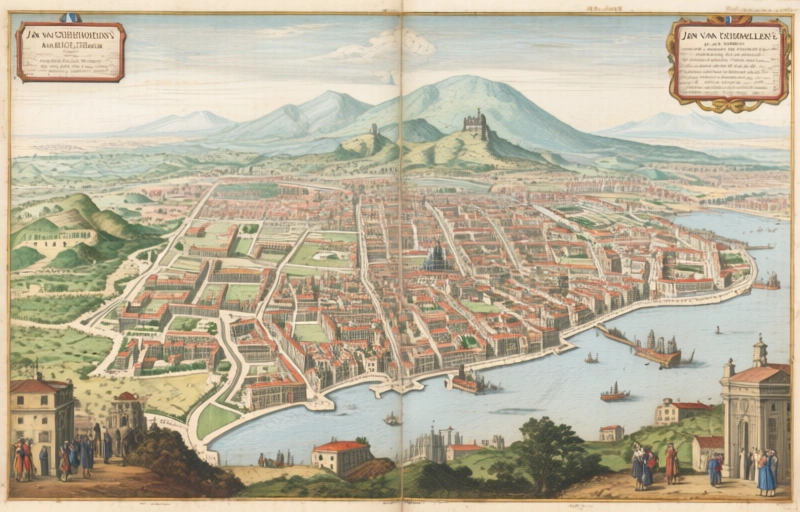
Back in 1582, a Dutch artist named Jan van Stinemolen did something pretty remarkable. He finished this massive, detailed panorama of Naples. But here's the twist – he didn't draw it from the water, looking at the famous bay like everyone else. Nope. He set up his view from the mainland, from the hills. It gives you this whole different feel for the city, blending the urban landscape with the countryside around it.
This ink-on-paper masterpiece now lives in Vienna's Albertina museum. And you'd think, with such an original take, it would have been analyzed to death by art historians, right? Well, that's where things get interesting.
### The Overlooked Masterpiece
Here's the surprising part. Even though scholars who study Naples's layout and experts in Dutch drawing techniques both know about this work, it hasn't gotten the deep dive it deserves. It's been sitting there, acknowledged but not fully understood. It's like having a famous book on your shelf that everyone's heard of, but nobody's actually written a proper review for.
That's finally changing. A group of researchers decided to tackle this gap head-on. They weren't just going to look at it the old way. They brought in new digital tools to get fresh eyes on Stinemolen's vision.
### A Collaborative Digital Deep Dive
This wasn't a solo project. It was a full-blown collaborative effort. The key to their approach? They used a treasure trove of digitized, annotated maps from the Bibliotheca Hertziana – that's the Max Planck Institute for Art History. These maps weren't just references; they were fundamental to the whole investigation.
The team had two clear goals in mind. First, they wanted to play a giant game of 'I Spy' with the drawing. Their mission was to identify as many of the locations, buildings, and sites that van Stinemolen included as humanly possible. Second, they dug into the artwork itself – its composition, how it was put together, and what it was trying to communicate beyond just being a pretty picture.
What they found was that this panorama is anything but a simple snapshot. It's a carefully constructed piece of art. Van Stinemolen made deliberate choices about what to include, what to emphasize, and how to frame the relationship between the city of Naples and the natural world that surrounds it. It's a statement, not just a record.
Think about it like this: most postcards from Naples show the glittering water and Mount Vesuvius in the background. Van Stinemolen's version makes you feel like you're a local walking in from the countryside, seeing your home from a familiar, land-bound approach. It connects culture with nature in a single, sweeping glance.
- It shifts the perspective from the sea to the land.
- It merges the urban and rural landscapes into one cohesive image.
- It represents a significant, yet understudied, work in topographical art.
This research project is a great reminder that sometimes, the most fascinating stories are hiding in plain sight. By combining traditional art history with modern digital archaeology, these scholars are giving us a new way to see an old city. They're proving that van Stinemolen's work is far more than a historical document; it's a complex artistic interpretation waiting for its moment in the spotlight.
So next time you think of a city view, remember it's all about where you stand. Van Stinemolen chose the hills, and in doing so, he gave us a timeless conversation between the built environment and the land it rests on.