Jan van Stinemolen's 1582 Naples Panorama: A New Perspective
Miguel Fernández ·
Listen to this article~4 min
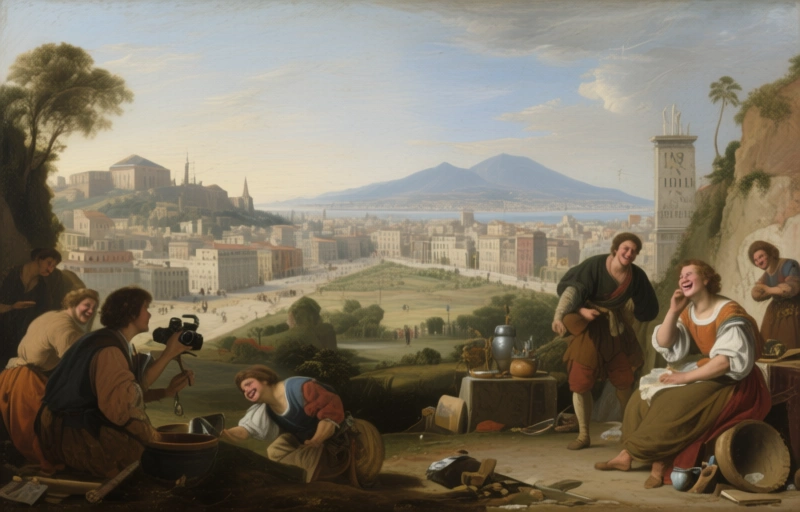
Jan van Stinemolen's 1582 panorama of Naples offers a rare inland perspective, overlooked by scholars. New research using digitized maps reveals it as a complex narrative, not a simple snapshot.
Back in 1582, a Dutch artist named Jan van Stinemolen did something pretty remarkable. He finished a massive, detailed panorama of Naples. But here's the twist – it wasn't the usual postcard view from the sea. Instead, he showed us the city from the land, from the hills looking in. This ink-on-paper masterpiece now lives in Vienna's Albertina museum, and honestly, it makes you see Naples in a whole new light.
You'd think such an original piece would have been picked apart by scholars by now, right? It's well-known among experts in both Neapolitan geography and Dutch drawing techniques. But surprisingly, it hasn't gotten the deep dive it truly deserves. The interpretations just haven't matched its significance. That's a gap we're aiming to fill.
### Why This View Matters
Stinemolen's choice to depict Naples from the mainland wasn't just artistic whimsy. It was a deliberate shift in perspective. While most artists were captivated by the famous bay, he turned his back to the water. This inland vantage point captures the relationship between the bustling city and the surrounding countryside – the culture and the nature, all woven together. It tells a more complete story of 16th-century life there.
We're not just looking at old maps and guessing, though. This fresh analysis comes from a collaborative research project with a powerful tool: digitized, annotated maps from the Bibliotheca Hertziana. This digital archive let us zoom in and cross-reference details in ways that weren't possible before. It was fundamental to our whole approach.
### More Than a Simple Snapshot
Our goal was twofold, and it revealed this work is far more complex than a simple historical snapshot. First, we wanted to identify as many of the specific sites and landmarks in the drawing as possible. Who or what was he showing us? Second, we dug into the artistic composition itself – its intermedial construction. How did Stinemolen build this view, and what choices did he make?
What we found is that this panorama is a carefully constructed narrative. It's not just topography; it's a statement. The research helps us see the connections between the urban core and the agricultural land, the palaces and the pastures. It gives us a richer, more nuanced understanding of the period.
Here are a few key qualities that make Stinemolen's work stand out:
- **An Uncommon Vantage Point:** Rejecting the iconic sea view for a terrestrial one.
- **A Blend of Genres:** It sits between a precise map and an artistic landscape.
- **A Document of Its Time:** It captures the city's expansion and its relationship with the hinterland.
- **Technical Mastery:** The detail in ink work for such a large scale is exceptional.
As one researcher noted, "This drawing forces us to reorient our understanding of how Naples was perceived, not just as a port, but as a city rooted in its land."
In the end, using these new analytical tools has opened up fresh perspectives. We're not just looking at an old drawing; we're piecing together a lost perspective on a famous city. For professionals in the field, it's a compelling case study in how digital archives and collaborative research can breathe new life into even the most studied artifacts. It reminds us that sometimes, to truly see something familiar, you just have to change your point of view.