Jan van Stinemolen's 1582 Naples Panorama: A New Perspective
Miguel Fernández ·
Listen to this article~4 min
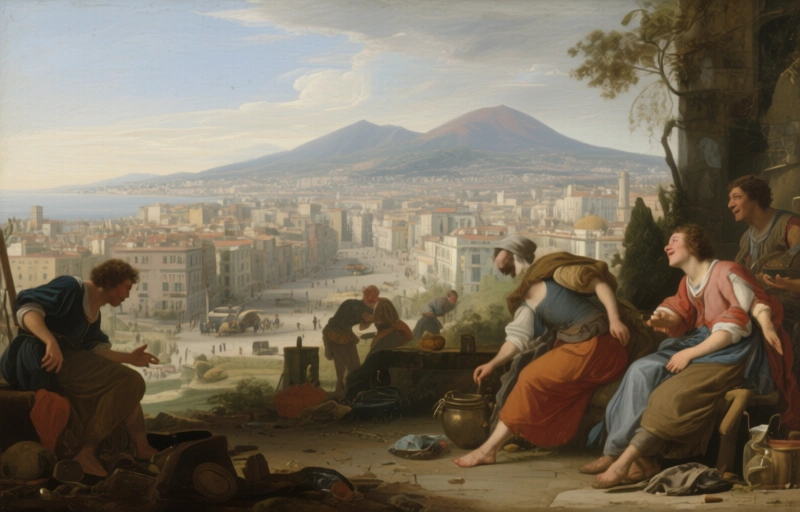
Discover Jan van Stinemolen's 1582 panorama of Naples, drawn from the hills rather than the sea. New research reveals this overlooked masterpiece as a complex artistic construction, not just a simple snapshot.
Let's talk about a drawing that changes how we see a city. In 1582, a Dutch artist named Jan van Stinemolen put ink to paper and created something monumental. He drew a complete panorama of Naples, Italy. But here's the twist – it wasn't the view everyone knew.
Most artists showed Naples from the water, looking toward the shore. Stinemolen flipped the script. He drew it from the hills looking inland. This original work now lives in Vienna's Albertina museum, and honestly, it deserves more attention than it's gotten.
### Why This Drawing Matters
Scholars who study Naples' landscape know this piece. Experts in Dutch drawing know it too. Yet somehow, it hasn't sparked the deep conversations it should. That's what makes this research project so exciting – we're finally giving this masterpiece the close look it deserves.
The team used some pretty cool tools to dig deeper. They worked with digitized maps from the Bibliotheca Hertziana, which is part of the Max Planck Institute for Art History. These annotated digital maps became their roadmap for understanding Stinemolen's vision.
### More Than Just A Pretty Picture
This wasn't just about making a list of buildings you can spot in the drawing. The researchers had two big goals:
- Pinpoint as many locations in the panorama as possible
- Unpack how Stinemolen actually constructed this view artistically
What they found surprised them. This isn't a simple snapshot of 1582 Naples. It's a carefully composed piece of intermedial art – meaning it blends different visual approaches and perspectives in one coherent work.
Think about that for a second. An artist in the 1500s created something so layered that we're still unpacking it with digital tools today. That tells you something about the complexity of his vision.
### The Collaborative Discovery Process
This research came from people working together across specialties. Topography experts talked with art historians. Digital archivists shared insights with traditional scholars. That cross-pollination of ideas led to fresh perspectives that wouldn't have emerged otherwise.
Here's what made their approach special:
- They treated the drawing as both art and historical document
- They used technology without letting it overshadow human interpretation
- They asked not just "what" is in the drawing, but "how" and "why"
One researcher noted, "The real discovery wasn't identifying landmarks – it was understanding how Stinemolen chose to frame the relationship between city and countryside."
### What We Learn About 1582 Naples
Through Stinemolen's eyes, we see a Naples that's connected to its landscape. The city doesn't float separately from the surrounding hills and farms. They flow into each other. This tells us about how people in the Renaissance perceived urban spaces – not as isolated centers, but as parts of larger ecological and cultural systems.
The drawing shows us:
- How the city's defenses integrated with natural terrain
- Where agricultural areas met urban development
- Which landmarks were visible from strategic vantage points
Most importantly, it reveals that Stinemolen wasn't just recording what he saw. He was making artistic choices about what to emphasize, what to connect, and what story to tell about this famous city.
### Why This Research Changes Things
For professionals working with historical visual materials, this project offers a new model. It shows how digital tools and traditional scholarship can work together to reveal layers of meaning that neither approach could uncover alone.
The next time you look at an old map or panorama, ask yourself: What is this artist trying to tell me? What did they choose to include or exclude? How did they arrange the elements to guide my eye and understanding?
Stinemolen's 1582 panorama of Naples isn't just a historical artifact. It's an invitation to see a familiar place through unfamiliar eyes. And sometimes, that's exactly what we need to understand both the past and the visual language that connects us to it.