Jan van Stinemolen's 1582 Naples Panorama: A Hidden View
Miguel Fernández ·
Listen to this article~4 min
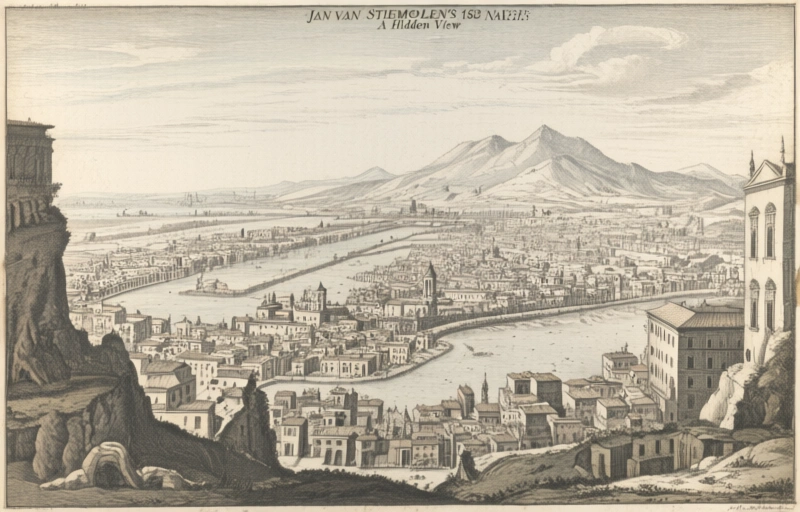
Discover Jan van Stinemolen's 1582 panorama of Naples, drawn from the inland hills instead of the bay. This overlooked masterpiece reveals the city's relationship with its countryside and is finally getting the scholarly attention it deserves.
Let's talk about a drawing that's been hiding in plain sight for centuries. In 1582, a Dutch artist named Jan van Stinemolen put the finishing touches on something truly special—a massive panorama of Naples. But here's the twist: he didn't draw the postcard view everyone knows. Instead of showing the city from the sparkling bay, he turned his back to the water. He captured Naples from the hills inland, looking toward the sea. That simple shift in perspective changes everything.
This incredible ink-on-paper work now lives at the Albertina Museum in Vienna. It's over 440 years old, measuring roughly 3 feet wide. Scholars who study Naples maps and experts in Dutch art both know it exists. Yet somehow, it's never gotten the deep dive it deserves. People have glanced at it, nodded, and moved on. But no one's really stopped to ask: what's actually going on here?
### Why This Drawing Is More Than a Snapshot
That's the gap a recent research project aimed to fill. A team decided to finally give this artwork the attention it's been waiting for. They weren't just going to look at it harder; they were going to look at it smarter. Their secret weapon? A treasure trove of digitized, annotated maps from the Bibliotheca Hertziana – Max Planck Institute for Art History.
By layering Stinemolen's drawing over these detailed historical maps, they could start to solve its puzzles. The goal was two-fold. First, they wanted to identify as many of the buildings, streets, and landmarks as possible. Second, they wanted to crack the code of its composition. How did Stinemolen put this thing together? What was he trying to say?
What they found was surprising. This isn't just a straightforward record of what Naples looked like in the late 1500s. It's a constructed view, a deliberate artistic statement. Stinemolen made choices—what to include, what to emphasize, how to frame the city against the countryside.
### The View From the Hills: City and Countryside
Choosing to draw Naples from the mainland hills wasn't a random decision. It was a conceptual one. This viewpoint blends the urban landscape with the natural world around it. You see the dense, built-up city, but you also see the farms, the vineyards, and the rolling terrain that supported it.
It shows the relationship between culture and nature, between the man-made and the organic. In one sweeping glance, you get a sense of how the city functioned within its larger environment. Where did its food come from? How was it defended? How did people travel to and from it? This drawing hints at all those answers.
The research revealed the drawing's "intermedial" construction. That's a fancy term for saying Stinemolen probably didn't just sit on a hill and sketch everything he saw. He likely combined different sources—maybe other drawings, maps, or even descriptions—to create this comprehensive, idealized panorama. It was a feat of artistic engineering.
So, what's the big takeaway? Jan van Stinemolen's 1582 panorama is a masterpiece of early cartographic art. It challenges the typical tourist perspective and offers a more holistic, grounded view of a legendary city. It reminds us that sometimes, to truly understand a place, you need to change your point of view completely. The next time you look at a historical cityscape, ask yourself: what story is the artist choosing to tell, and what story might they be leaving out?