Jan van Stinemolen's 1582 Naples Panorama: A Hidden View
Miguel Fernández ·
Listen to this article~4 min
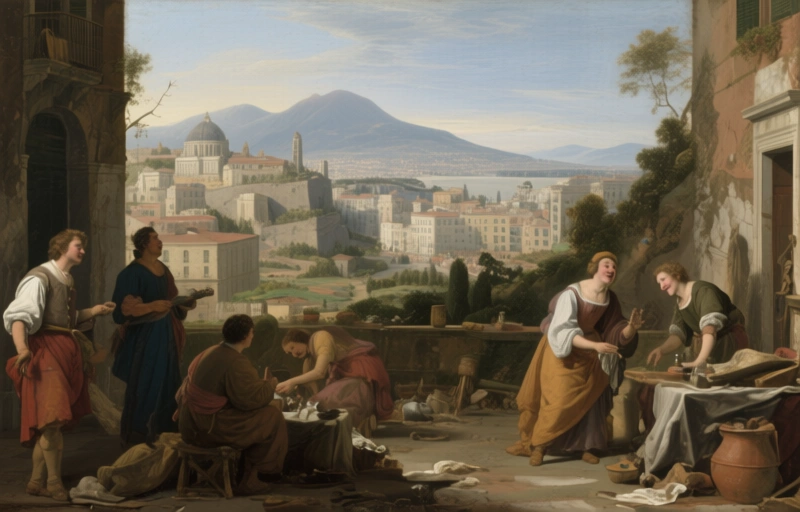
In 1582, Jan van Stinemolen drew a unique panorama of Naples from the hills, not the sea. This overlooked masterpiece, blending map and art, is finally getting the deep analysis it deserves through new digital research.
Let's talk about a piece of art that's been hiding in plain sight. Back in 1582, a Dutch artist named Jan van Stinemolen put ink to paper and created something truly monumental. He drew a massive panorama of Naples, Italy. But here's the twist—it wasn't the famous postcard view from the sea that everyone knew. Nope. He showed us the city from the land, from the hills looking in. It's a perspective shift that changes everything.
This incredible drawing now lives in the Albertina Museum in Vienna. It's on paper, detailed in ink. Scholars who study Naples's landscape and experts in Dutch drawing techniques both know it exists. But honestly? It hasn't gotten the deep dive it deserves. It's like finding an old, unopened letter in your attic—everyone knows it's there, but nobody's really sat down to read the whole story.
### Why This View Matters So Much
Think about it. For centuries, artists painted Naples from the water. The sparkling bay, Vesuvius in the background—it's the iconic shot. Stinemolen flipped the script. By drawing from the mainland, he captured the relationship between the bustling city and the quiet countryside. He showed the culture *and* the nature, all woven together. This wasn't just a pretty picture; it was a complex statement.
A group of researchers decided it was finally time to give this work its due. They launched a collaborative project, and their secret weapon was a treasure trove of digitized, annotated maps from the Bibliotheca Hertziana. These weren't just any maps; they were fundamental to cracking the code of Stinemolen's vision.
### The Two-Part Mission
The team had a clear, two-part goal. First, they wanted to identify as many real-life locations in the drawing as possible. Where exactly was he standing? Which church spire is that? Which hilltop village? Second, they dug into the artistic composition itself. How did he build this scene? What techniques did he use to create depth and narrative?
What they found was fascinating. This is far from a simple snapshot. It's a carefully constructed, intermedial piece of work. The term 'intermedial' just means it blends different forms of representation—part map, part landscape painting, part historical document.
- **It's a historical record:** It freezes a moment in 1582 Naples, showing buildings and landscapes that may have changed or vanished.
- **It's an artistic feat:** The composition guides your eye, telling a story about the city's place in its environment.
- **It's a cartographic hybrid:** It uses the precision of a mapmaker but delivers the beauty of a fine art drawing.
One researcher put it perfectly: "This work asks us to reconsider what a 'view' of a city can be. It's not passive observation; it's an active interpretation."
Using those digitized maps as a guide, the team could place Stinemolen's viewpoint with surprising accuracy. They traced the ridges and valleys, matching his lines to the actual topography. This allowed them to understand not just *what* he drew, but *why* he might have chosen that specific vantage point. Was it for the best light? To make a political point? To show the city's defenses?
The answers are still unfolding. This research is opening fresh perspectives, proving that a 440-year-old drawing still has new secrets to reveal. It reminds us that sometimes, to truly see a place, you have to change your point of view entirely. Stinemolen did that in 1582, and now, finally, we're learning to see his masterpiece through new eyes as well.