Decoding Jan van Stinemolen's Panorama of Naples
David Williams ·
Listen to this article~5 min
Uncover the secrets behind Jan van Stinemolen's 1582 Panorama of Naples. Explore the key bibliography, digitized maps, and research that reveal how this masterpiece is far more than a simple city snapshot.
### Unlocking a 16th-Century Masterpiece
You might think a panoramic drawing from 1582 is just a pretty picture of an old city. But Jan van Stinemolen's *Panorama of Naples* is way more than that. It's a complex puzzle, a mix of art, history, and science that's taken a team of experts to decode.
This isn't your typical bibliography. We're diving into the key texts and maps that helped researchers crack the code of this monumental work. Think of it as a behind-the-scenes look at how we connect the dots between art and reality.
### What Makes This Drawing So Special?
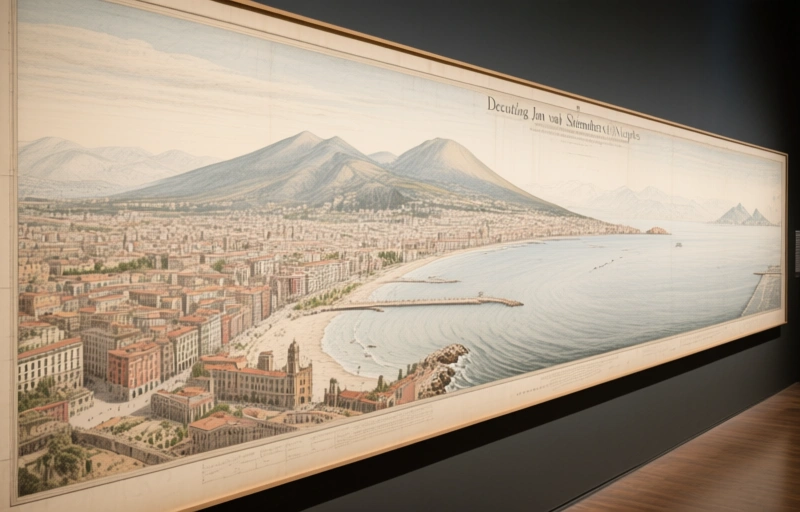
First off, the scale is huge. We're talking about a drawing that's over 8 feet long. It shows Naples from a bird's-eye view, capturing everything from the coastline to the city's famous castles. But here's the kicker: it's not just a simple snapshot. Stinemolen played with perspective, composition, and even added details that weren't there in real life.
So why does that matter? Because understanding his choices tells us a lot about how people in the 16th century saw their world. It's not just about what Naples looked like; it's about how they *wanted* it to be seen.
### The Research Behind the Image
The project had two main goals:
- **Identify every site** in the drawing, from churches to palaces.
- **Figure out how** Stinemolen put it all together.
To do that, the team turned to digitized maps from the Bibliotheca Hertziana – Max Planck Institute for Art History. These old maps, some dating back to the 1500s, were like GPS coordinates for the past. By overlaying them with Stinemolen's drawing, researchers could pinpoint exact locations.
But it wasn't just about matching dots. They also looked at the artistic composition. For example, why did Stinemolen exaggerate the size of certain buildings? And how did he blend different viewpoints into one seamless panorama?
### Key Sources You Should Know
If you're diving into this topic, here are the essential reads:
- **"Naples in the 16th Century: A Cartographic History"** – This book breaks down the evolution of city maps and how they influenced artists like Stinemolen.
- **"The Art of the Panorama"** – A deep dive into the techniques used to create panoramic views before photography.
- **Digitized Map Archives** – The online collection at the Bibliotheca Hertziana is a goldmine. You can zoom in and see the same maps the researchers used.
These sources aren't just for academics. If you're a history buff or an artist, they'll give you a new appreciation for how we piece together the past.
### What We Learned
So, what did the research uncover? A lot. For starters, Stinemolen didn't just copy what he saw. He rearranged the city to make it look more impressive. Think of it like a photographer using a wide-angle lens to fit everything in, but then also moving a few buildings around for a better shot.
> "This drawing is far from a simple snapshot of Naples in 1582." – Project researchers
That quote sums it up. Stinemolen was an artist, not a cartographer. His goal was to create a masterpiece, not a perfect map. And that's what makes it so fascinating.
### Why This Matters Today
You might wonder why we're still talking about a 400-year-old drawing. Here's the thing: it teaches us about how people perceive and represent their world. In an age of Google Maps and satellite imagery, it's easy to forget that every map is a choice. Every drawing is a story.
This project also shows the power of collaboration. Art historians, cartographers, and digital archivists worked together to unlock the secrets of this panorama. It's a reminder that the best discoveries happen when we share what we know.
### Final Thoughts
Whether you're a student, a researcher, or just someone who loves old maps, there's something here for you. The bibliography we've put together is a starting point. Dive in, explore the digitized maps, and see what you can find. You might just discover a new way of looking at the past.
And if you ever get the chance to see Stinemolen's *Panorama of Naples* in person, take it. Up close, you'll see details that no photo can capture. It's a window into a world that's both familiar and completely foreign.