Decoding Jan van Stinemolen's Panorama of Naples (1582)
Miguel Fernández ·
Listen to this article~4 min
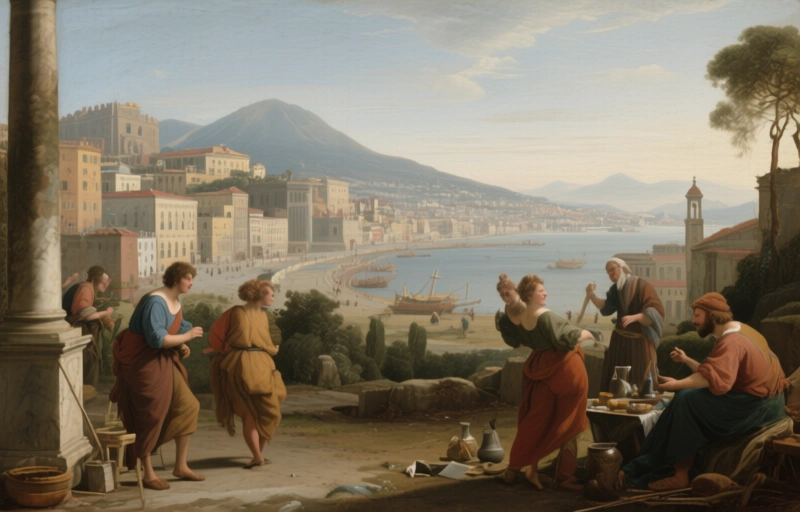
Explore the research behind Jan van Stinemolen's 1582 Panorama of Naples. Discover how scholars moved beyond seeing it as a simple snapshot to decoding its artistic narrative and hidden meanings.
Let's talk about a piece of history that's way more than just a pretty picture. Jan van Stinemolen's *Panorama of Naples* from 1582 isn't your average Renaissance drawing. It's a complex puzzle, a layered document that's kept researchers busy for years. We're diving into the essential bibliography and research that helps us understand what we're really looking at.
You see, for a long time, people treated it like a historical snapshot—a simple record of what Naples looked like in the late 16th century. But that's selling it short. It's an artistic composition, carefully constructed. The collaborative project we're discussing had a clear, two-part goal: to pinpoint the actual locations Stinemolen depicted and to unpack how he built this visual narrative.
### Why This Drawing Is So Much More
The first challenge was straightforward, but incredibly tough. Identifying the sites. Stinemolen's panorama is monumental, crammed with buildings, streets, and landmarks. Researchers had to become detectives, cross-referencing every detail with other historical sources. This wasn't a solo mission. It involved digging through archives and, crucially, working with digitized maps from the Bibliotheca Hertziana.
Those annotated digital maps were a game-changer. They let scholars overlay old and new, tracing the evolution of the city's layout. It's like having a time-traveling GPS. This technical approach was fundamental—it provided the concrete geographical foundation. Without it, we'd just be guessing at which church is which or which hill is being shown.
### The Artistic Puzzle Beneath the Surface
But the real magic happened with the second aim: investigating the artistic and 'intermedial' construction. That's a fancy term for how it borrows and blends from different media—think maps, paintings, and maybe even theatrical scenes. This investigation revealed Stinemolen wasn't just copying what he saw. He was composing, editing, and telling a story.
He might have emphasized certain buildings for symbolic reasons, or arranged the cityscape to guide the viewer's eye on a specific journey. The research asks: What was he trying to communicate about Naples? Power? Piety? Civic pride? The bibliography includes titles that explore these interpretations, moving us from simple identification to deep understanding.
Here’s what the research fundamentally changed:
- It shifted the view from *topography* to *narrative*.
- It revealed artistic choices over documentary ones.
- It connected the drawing to broader cultural practices of the time.
As one scholar noted in the research, **“The panorama is a statement, not just a survey.”** This quote really captures the shift in thinking. It’s not a passive record; it’s an active argument made with pen and ink.
So, this bibliography and the project it comes from are essential tools. They're not just a list of books. They're a roadmap that shows how far we've come in understanding this work. They compile the resources that helped crack the code—from old property records to digital map layers—and the essays that explain what it all means.
For professionals, this represents a methodological case study too. It shows how traditional art history can team up with digital archiving and spatial analysis to ask new questions of old objects. The next time you look at a historical panorama, you won't just see a city. You'll see choices, construction, and a hidden layer of meaning waiting to be unpacked. That's the real value of diving deep into the research behind Stinemolen's masterful, mysterious view of Naples.