Decoding Jan van Stinemolen's Panorama of Naples (1582)
Miguel Fernández ·
Listen to this article~4 min
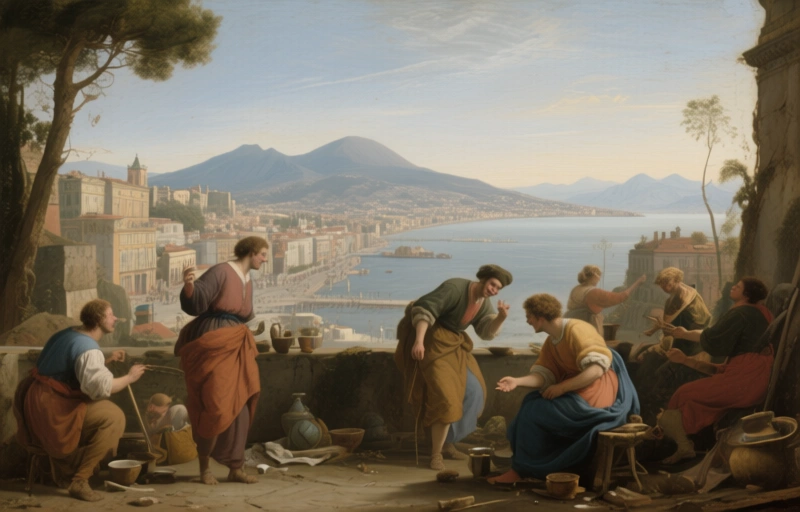
Explore the research behind Jan van Stinemolen's 1582 Panorama of Naples, revealing it as a complex artistic construction, not a simple snapshot. Discover the collaborative project that decoded its sites and meaning.
If you're like me, you've probably seen old maps and drawings and thought they were just simple records of a place. A snapshot in time, right? Well, let me tell you about Jan van Stinemolen's *Panorama of Naples* from 1582. It's so much more than that. This monumental drawing isn't just a picture of a city—it's a complex artistic statement, a puzzle waiting to be solved, and a research project that brought together some brilliant minds.
I recently dove into the essential bibliography and research surrounding this work, and what I found completely changed how I view historical cartography. The collaborative effort to understand Stinemolen's vision was nothing short of fascinating.
### The Two-Fold Mission of the Research
The team had a clear, dual goal from the start. First, they wanted to play detective. They aimed to identify as many of the specific sites and buildings visualized in Stinemolen's sprawling, detailed drawing as possible. Imagine looking at a 440-year-old panorama and trying to match each church, tower, and street to real locations. It's a massive undertaking.
Second, and this is where it gets really interesting, they wanted to investigate the drawing's artistic soul. They looked beyond the 'what' to ask 'how' and 'why.' How did Stinemolen compose this scene? What artistic choices did he make? This investigation into its composition and what scholars call its 'intermedial construction'—how it interacts with and references other media—revealed the truth. This panorama is a carefully crafted piece of art, not a casual sketch.
### The Tools That Made It Possible
This research didn't happen in a vacuum. A key resource was the collection of digitized maps held at the Bibliotheca Hertziana – Max Planck Institute for Art History. Think of these as the reference library. The researchers annotated these maps, cross-referencing every detail with Stinemolen's work. These maps were fundamental. They provided the ground truth against which the artistic interpretation could be measured and understood.
Without this digital archive, the project would have been infinitely harder, if not impossible. It's a perfect example of how traditional art history and modern technology can work hand-in-hand to uncover new meanings.
### Why This Matters for Professionals
So, why should you care about a Renaissance drawing of Naples? Because this project exemplifies a modern approach to historical analysis. It shows that our understanding of historical works is never complete. There are always new layers to uncover, especially when we ask different questions.
- **It challenges assumptions:** Moving from seeing it as a 'snapshot' to understanding it as a 'constructed view' changes everything.
- **It highlights collaboration:** Major insights came from a team with diverse expertise, not a single scholar working alone.
- **It leverages technology:** Digitized resources were not just convenient; they were central to the methodology.
As one researcher involved noted, "The real discovery was realizing how much narrative and intention Stinemolen packed into a single sheet. It's a guided tour, not just a map."
### The Bigger Picture
What the team found was revelatory. Stinemolen wasn't just documenting Naples; he was interpreting it, shaping the viewer's experience through his artistic choices. The placement of buildings, the play of light, the selection of what to include and what to omit—all of it was deliberate. This work is a bridge between cartography, landscape art, and urban history. It reminds us that historical sources are rarely neutral. They are created by people with perspectives, tools, and intentions. Unpacking those elements is where the real story lies. For anyone working with historical visual materials, this project is a masterclass in looking deeper, questioning the surface, and appreciating the complex artistry behind what might first appear to be a simple record of the past.