Decoding Jan van Stinemolen's 1582 Panorama of Naples
Miguel Fernández ·
Listen to this article~4 min
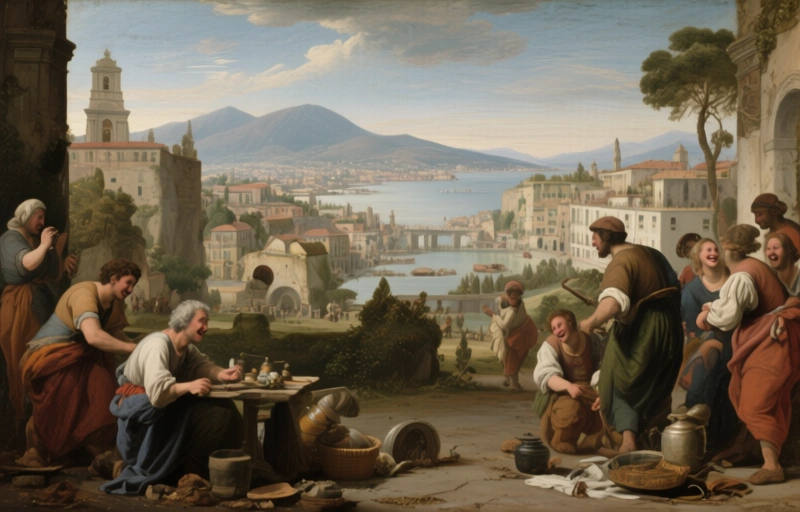
A deep dive into the research behind Jan van Stinemolen's 1582 Panorama of Naples, revealing it as a complex artistic construction, not just a simple city snapshot.
If you're working with historical art or cartography, you've probably come across Jan van Stinemolen's *Panorama of Naples* from 1582. It's one of those pieces that looks simple at first glance—just a detailed drawing of a city, right? But that's where things get interesting. This isn't a simple snapshot. It's a carefully constructed artistic statement, and understanding it requires digging deeper than the surface.
We recently wrapped up a collaborative research project focused entirely on this work. Our goal was straightforward but ambitious: to peel back the layers of this monumental drawing and see what was really going on. What we found surprised even us. This panorama is far more than a geographical record.
### What Makes This Panorama So Special?
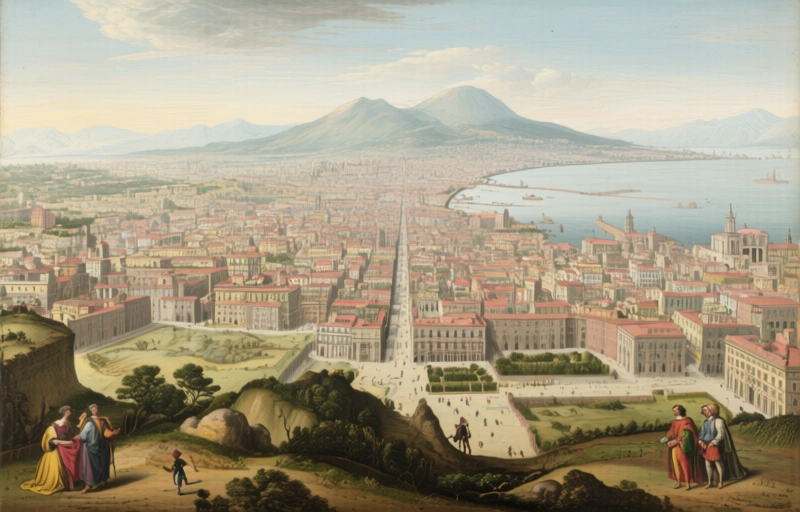
The first thing you notice is the sheer scale. Stinemolen didn't just sketch a few landmarks. He attempted to capture the entire cityscape of Naples in 1582 with remarkable detail. But here's the catch—it's not photorealistic. The composition, the placement of buildings, the perspective... it's all intentional. It's an intermedial construction, blending map-making with artistic vision. He wasn't just documenting; he was interpreting.
Our project had two main objectives. First, we wanted to identify as many real-world sites as possible. Which churches, fortifications, and streets did he include? Second, and more crucially, we investigated the *how* and *why* of his artistic choices. Why arrange the city this way? What story was he trying to tell beyond mere topography?
### The Tools That Made It Possible
You can't tackle a project like this without the right resources. We relied heavily on digitized historical maps, many of which were meticulously annotated. These weren't just references; they were fundamental to our methodology. By comparing Stinemolen's work to contemporary and later maps, we could see his deviations from pure cartography.
- **Comparative Analysis:** We placed his drawing alongside known city plans from the period.
- **Site Verification:** We cross-referenced architectural features with historical records.
- **Artistic Evaluation:** We analyzed line work, shading, and compositional balance as artistic decisions.
This approach revealed the panorama's dual nature. It's both a valuable historical document *and* a standalone work of art. Stinemolen made choices—what to emphasize, what to minimize—that a surveyor wouldn't.
### Why This Research Matters for Professionals
So, why should this matter to you if you're in the field? Because it changes how we interact with historical visual media. When we stop viewing works like this as passive records and start seeing them as active constructions, a whole new world of interpretation opens up.
Think about it. Every map, every city view, every panorama from this era carries the bias and intention of its creator. Recognizing that allows for a richer, more nuanced understanding of the past. It's not just about *where* things were, but *how* people chose to see and represent their world.
As one researcher noted during the project, "The panorama doesn't show us Naples as it was, but Naples as Stinemolen wanted us to see it." That's a powerful distinction. It reminds us that even the most technical-looking works are filtered through human perception and purpose.
This investigation pushes us to ask better questions of historical sources. Next time you examine an old map or drawing, don't just look for accuracy. Look for artistry. Look for narrative. You might be surprised by what you find hiding in plain sight.