Decoding Jan van Stinemolen's 1582 Panorama of Naples
Miguel Fernández ·
Listen to this article~5 min
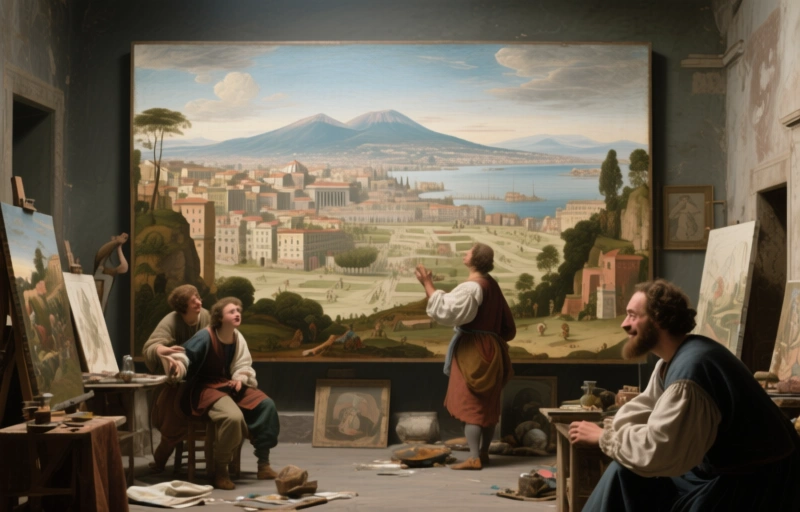
Discover how Jan van Stinemolen's 1582 Panorama of Naples blends art and cartography. Our research reveals this monumental drawing as a carefully constructed vision, not just a simple snapshot of the city.
If you're working with historical art or cartography, you've probably come across Jan van Stinemolen's *Panorama of Naples* from 1582. It's one of those pieces that looks simple at first glance—just a detailed drawing of a city, right? But here's the thing: it's so much more than that. This monumental work isn't a simple snapshot. It's a carefully constructed artistic vision that reveals how people saw and represented space in the late Renaissance.
We recently dove deep into this drawing as part of a collaborative research project. Our goal was straightforward but ambitious. We wanted to peel back the layers of this work and understand what Stinemolen was really showing us.
### What Makes This Panorama Special?
First, let's talk about what we were looking at. Stinemolen's drawing is massive in scope and detail. It captures Naples at a specific moment in time, but it does so with artistic intention. This isn't photography—it's interpretation. The composition, the perspective, the choices about what to include and what to emphasize... all of these elements tell a story beyond just "here's what the city looked like."
Our research had two main objectives:
- To identify as many real-world locations within the drawing as possible
- To analyze the artistic and intermedial construction of the work
That second point is crucial. "Intermedial" just means it exists between different forms of media—in this case, between cartography and art. Stinemolen wasn't just making a map. He was creating something that functioned as both documentation and artistic expression.
### The Research Approach
We didn't work in a vacuum. Our methodology relied heavily on existing scholarship and some incredible resources. The digitized maps from the Bibliotheca Hertziana were particularly valuable. These annotated maps gave us reference points and helped us understand how 16th-century cartographers viewed the same spaces Stinemolen was depicting.
Here's what we discovered through this process:
- The drawing contains numerous identifiable sites that correspond to real locations in 1582 Naples
- The artistic composition reveals deliberate choices about viewpoint and framing
- The work functions as a hybrid form—part map, part artistic panorama
- Stinemolen's approach was far from neutral or purely documentary
### Why This Matters for Professionals
You might be wondering why this level of analysis matters. Well, if you're working with historical visual materials, understanding their constructed nature changes everything. It means you're not just looking at "what" is shown, but "how" and "why" it's shown that way.
This perspective transforms how we interpret historical sources. We stop treating them as transparent windows to the past and start seeing them as mediated representations. That shift is powerful. It opens up new questions and new understandings of historical moments and artistic practices.
As one researcher noted during our project: "The Panorama of Naples teaches us that every representation is an argument about how space should be understood and remembered."
### Key Takeaways from Our Findings
Our collaborative work revealed several important insights about Stinemolen's panorama:
- **It's intentionally composed** - The viewpoint and framing create specific effects and emphasize certain aspects of the city
- **It blends genres** - The work exists between artistic panorama and functional cartography
- **It's selective** - Like any representation, it shows some things while omitting others
- **It has artistic agency** - Stinemolen made choices that went beyond mere documentation
These findings matter because they help us understand how people in the past visualized their world. They show us that even seemingly straightforward documents come with perspective, bias, and artistic intention built right in.
### Moving Forward with Historical Visual Analysis
So what does this mean for your work? Whether you're dealing with historical drawings, maps, or other visual materials, our approach suggests some useful strategies:
- Always question the viewpoint and framing of visual sources
- Look for what's included and what's excluded
- Consider the medium and its conventions
- Compare multiple representations of the same subject
- Remember that every visual source has a creator with intentions
Stinemolen's panorama isn't just a picture of Naples in 1582. It's a statement about how one artist saw and wanted others to see that city. Understanding that distinction changes how we work with historical visual materials across the board.
The work continues, of course. Every drawing, every map, every visual representation from the past has stories to tell—if we know how to listen with our eyes.