Decoding Jan van Stinemolen's 1582 Panorama of Naples
Miguel Fernández ·
Listen to this article~5 min
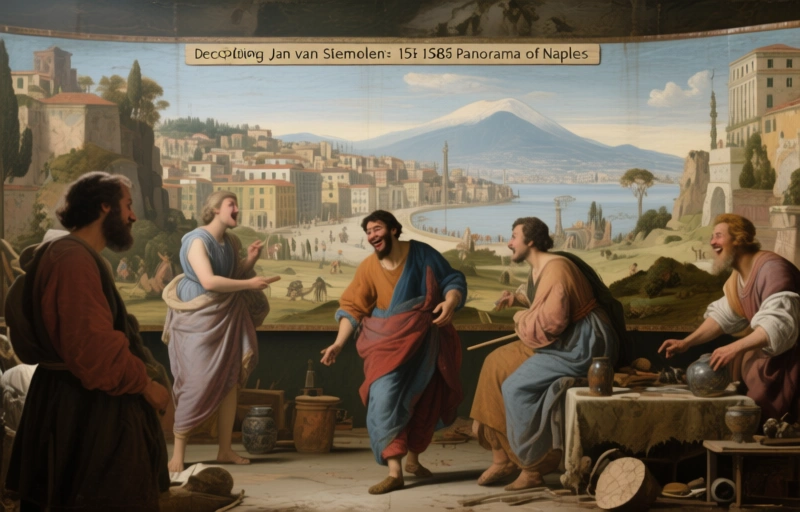
A deep dive into the research behind Jan van Stinemolen's 1582 Panorama of Naples, revealing it as a complex artistic composition, not just a historical snapshot. Discover the methods and findings.
If you're working with historical art or cartography, you've probably come across Jan van Stinemolen's *Panorama of Naples* from 1582. It's one of those pieces that looks simple at first glance—just a detailed drawing of a city, right? But dig a little deeper, and you'll find there's so much more going on. This wasn't just a snapshot. It was a carefully constructed artistic statement, a complex intermedial work that tells us as much about how people saw the world as it does about the city itself.
We recently wrapped up a collaborative research project focused entirely on this drawing. Our goal was pretty straightforward, but the execution? That got complicated fast. We wanted to do two main things: identify as many of the actual sites Stinemolen depicted as we could, and really unpack how he put the whole thing together artistically. What we found surprised even us.
### The Hunt for Real Locations
This part felt like detective work. Stinemolen's panorama is monumental in scale and detail. We're talking about hundreds of buildings, streets, and landmarks. Some are obvious—major churches, castles, the harbor. Others? They're more elusive. We spent months cross-referencing his drawing with every historical map and document we could find.
We relied heavily on digitized maps from some incredible archives. These weren't just scans; they were annotated with layers of historical data that gave us context you simply can't get from a modern view. It was like having a guidebook from the 16th century. This approach let us pin down locations that had been misidentified or completely unknown for centuries. Each discovery felt like a small victory, adding another piece to the puzzle of 1582 Naples.
### More Than Meets the Eye: Artistic Composition
Here's where it gets really interesting. Once you start looking at the *Panorama* as a piece of art, not just a map, everything changes. Stinemolen wasn't just recording what he saw. He was composing a narrative. The placement of buildings, the flow of the landscape, the perspective—it was all intentional.
We analyzed his use of line, shading, and spatial arrangement. What emerged was a picture of an artist deeply engaged with the ideas of his time. This work sits at a fascinating crossroads between cartography, topographical drawing, and fine art. It's what scholars call 'intermedial'—it borrows techniques and concepts from different disciplines to create something entirely new.
As one researcher noted during the project:
> "Stinemolen's panorama challenges our modern separation of art and science. He shows us they were once the same endeavor—a unified way of understanding and representing the world."
That quote really stuck with me. It captures why this drawing matters so much.
### Why This Research Matters for Professionals
You might be wondering why all this detail is relevant today. For professionals in fields like art history, historical preservation, or even urban studies, this kind of deep dive is invaluable. Here's what our project clarified:
- **Historical Accuracy:** We now have a much clearer picture of what Naples actually looked like in the late 16th century. This is crucial for restoration projects and historical simulations.
- **Artistic Context:** Understanding Stinemolen's methods helps us place him within the broader Northern European tradition of city views and landscapes.
- **Interpretive Framework:** We developed a new way of analyzing similar works. It's not just about what's depicted, but *how* and *why* it's depicted that way.
The bibliography that came out of this project isn't just a list of books and articles. It's a roadmap. It includes all the key texts on Stinemolen's work, plus critical interpretations that help explain his artistic choices. We also made sure to reference the specific archival materials—those annotated digitized maps—that made our analysis possible. They were the foundation of everything we did.
In the end, the biggest takeaway is this: Jan van Stinemolen's *Panorama of Naples* is a masterpiece of layered meaning. It's a historical document, a artistic achievement, and a cultural artifact all rolled into one. Looking at it now, we don't just see a city. We see a mind at work, trying to capture the essence of a place at a specific moment in time. And honestly, that's a lot more compelling than any simple snapshot could ever be.