Decoding Jan van Stinemolen's 1582 Panorama of Naples
Miguel Fernández ·
Listen to this article~4 min
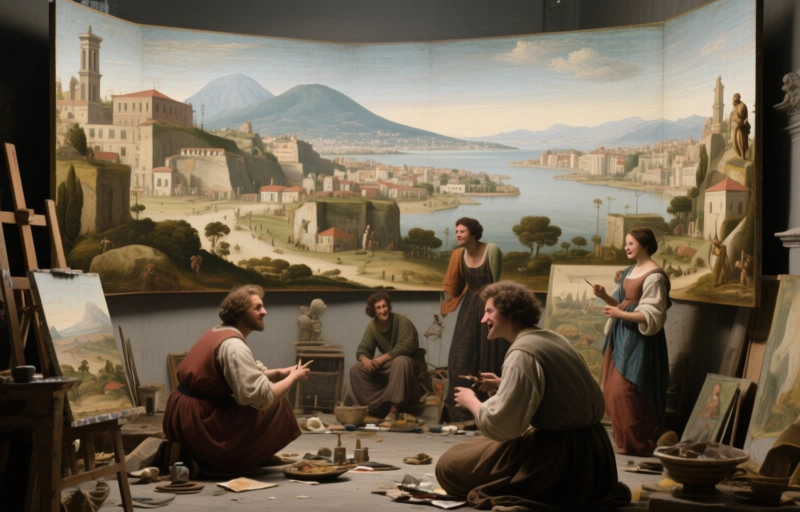
Explore the research behind Jan van Stinemolen's 1582 Panorama of Naples. Discover why this drawing is a complex artistic puzzle, not a simple snapshot, and learn about the collaborative project to decode its secrets.
Let's talk about something that's way more than just an old drawing. Jan van Stinemolen's *Panorama of Naples* from 1582 isn't a simple snapshot. It's a complex artistic puzzle that researchers have been trying to solve for years. Think of it like a historical detective story, where every line and detail holds a clue about the city's past.
I recently dove into the essential bibliography and research surrounding this work, and what I found completely changed how I see it. This isn't just art history—it's a window into how people documented and understood their world centuries ago. The collaborative effort to unpack it has been massive.
### What Was the Research Project Really About?
The core mission was pretty straightforward, but incredibly challenging. First, the team wanted to identify as many real-life locations in the drawing as possible. Imagine trying to match a 440-year-old artistic rendition to modern maps and historical records. It's painstaking work.
Second, they aimed to investigate the drawing's artistic composition. How did Stinemolen put this thing together? What techniques did he use? This is where it gets fascinating, because the research revealed this panorama is a carefully constructed piece, not a spontaneous sketch.
### The Tools That Made It Possible
This project leaned heavily on some incredible resources. Digitized maps from the Bibliotheca Hertziana were absolutely fundamental. Having these annotated references allowed researchers to cross-check details with a precision that wasn't possible before the digital age.
- **Annotated Maps:** These provided the geographical backbone for the entire study.
- **Comparative Analysis:** Researchers could place the drawing alongside other historical documents.
- **Collaborative Verification:** Teams could work together to confirm site identifications.
The approach wasn't about looking at the drawing in isolation. It was about building a context around it, using every available tool to understand the artist's intent and the city's layout.
### Why This Drawing Is So Special
Here's the key takeaway that blew my mind. The research clearly shows this work is "far from a simple snapshot of Naples in 1582." That phrase stuck with me. It means Stinemolen wasn't just recording what he saw. He was interpreting it, composing it, and maybe even editorializing through his art.
What does "intermedial construction" mean in plain English? It suggests the drawing borrows from different media and methods. Maybe it combines cartographic techniques with artistic flair. Perhaps it blends accuracy with aesthetic choices. It's a hybrid creation.
### The Bigger Picture for Professionals
For anyone working with historical art or documentation, this project is a masterclass in methodology. It shows how to tackle a monumental piece by breaking it into manageable questions. Identify the sites. Understand the construction. Only then can you grasp the full meaning.
The bibliography that came out of this isn't just a list of books. It's a roadmap of the intellectual journey. It includes titles on interpretation, because understanding *how* to look at this drawing is as important as knowing *what* you're looking at.
In the end, this research does more than explain one drawing. It gives us a framework for looking at any historical artwork. It teaches us to ask: What is the artist really showing us? And more importantly, what are they trying to say? That's a lesson that goes way beyond 16th-century Naples.