Decoding Jan van Stinemolen's 1582 Panorama of Naples
Miguel Fernández ·
Listen to this article~5 min
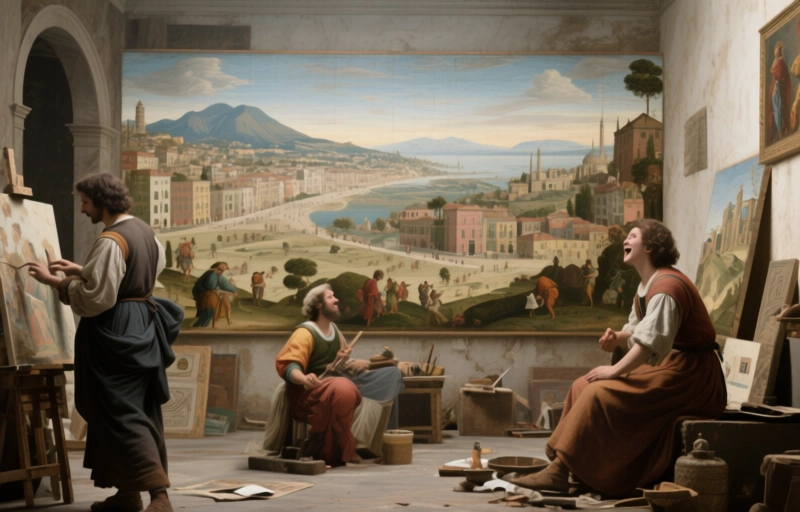
Explore the research behind Jan van Stinemolen's 1582 Panorama of Naples. Discover how this drawing is more than a snapshot—it's a complex artistic interpretation of the city that required collaborative analysis and digitized historical maps to fully understand.
Let's talk about something that's been fascinating our team at Abbevillemusique lately. It's not just a drawing—it's a puzzle, a historical document, and a work of art all rolled into one. We're diving deep into Jan van Stinemolen's *Panorama of Naples* from 1582, and honestly, it's far more complex than anyone first thought.
You see, when you glance at this monumental drawing, you might think it's just a snapshot of the city. But that's where you'd be wrong. Our collaborative research project set out with two clear goals, and what we discovered changed our entire perspective.
### What We Wanted to Uncover
First, we wanted to identify as many locations as possible within Stinemolen's work. It sounds straightforward, right? Just match buildings and streets. But here's the thing—the drawing isn't a perfect geographical record. It's an interpretation, an artistic composition that blends reality with something more deliberate.
Second, we needed to investigate how this panorama was actually constructed. What artistic choices did Stinemolen make? How did he use different media and techniques to create this intermedial piece? This wasn't about finding a simple map—it was about understanding an artist's vision of a city at a specific moment in time.
### The Tools That Made It Possible
This work wouldn't have been possible without some incredible resources. We relied heavily on digitized maps from a major European art history institute. These annotated maps gave us the foundation we needed to approach Stinemolen's drawing with fresh eyes.
Think of it like having a key to a coded message. The maps provided the real-world coordinates, while Stinemolen's drawing showed us how an artist filtered and presented that reality. The comparison was revealing, to say the least.
Here's what made our bibliography particularly valuable:
- It includes not just primary sources but critical interpretations
- We incorporated titles that explore the drawing's artistic merit beyond its historical value
- The digitized resources allowed for detailed, side-by-side analysis
- Collaborative annotations helped build a more complete picture
### Why This Matters for Professionals
If you're working in ethnomusicology or digital archiving, you know that context is everything. Stinemolen's panorama isn't just a pretty picture—it's a cultural artifact that tells us about how people saw their world in the late 16th century.
As one researcher noted during our project, "The Panorama of Naples reveals as much about artistic convention as it does about urban geography." That insight became central to our approach. We stopped looking for perfect accuracy and started looking for intentional choices.
What we found was fascinating. The drawing uses perspective creatively, emphasizes certain landmarks over others, and creates a narrative about Naples that goes beyond mere documentation. It's a constructed view, carefully composed to convey specific ideas about the city's importance and character.
### The Bigger Picture
This research has implications beyond art history. For digital archivists, it shows how layered interpretation can be. A single artifact can serve multiple purposes—historical record, artistic expression, cultural statement. Our job is to preserve all those layers, not flatten them into one simple category.
For ethnomusicologists, there's another angle. Think about how music and sound might have filled the spaces Stinemolen depicted. What would you hear walking those streets in 1582? The drawing gives us visual clues, but our imagination—and other historical sources—have to fill in the auditory landscape.
### Moving Forward with This Research
We're not done with this project, not by a long shot. The bibliography we've compiled is just the starting point. There are still sites in the drawing we haven't positively identified, and artistic choices we haven't fully unpacked.
What's exciting is how this work connects different disciplines. Art historians, digital archivists, urban geographers—we all have something to learn from Stinemolen's panorama. And by working together, we're building a much richer understanding than any of us could achieve alone.
So next time you encounter what seems like a straightforward historical document, take a closer look. Ask what choices the creator made. Consider what they emphasized and what they left out. Because as we learned with the Panorama of Naples, sometimes the most interesting stories aren't in what's shown, but in how and why it's shown that way.