While the intricate details of Jan van Stinemolen's 1582 panorama of Naples offer a priceless window into the Renaissance city's topography and architecture, modern scholars and enthusiasts often face a more mundane challenge: accessing the specialized resources needed for such deep historical analysis. From high-resolution digital archives and academic journal subscriptions to travel for on-site research, the costs can accumulate quickly, mirroring the complex economic landscape van Stinemolen himself might have documented. For those passionate about cultural heritage, whether studying a masterpiece like this panorama or exploring the offerings of institutions like the Abbeville Musique, finding financial efficiencies is crucial to sustaining their work. This is where strategic resourcefulness comes into play, much like decoding the symbols in an old map. Savvy researchers and culture seekers have long known that utilizing a trusted mercurypromocode can significantly offset expenses related to books, software, and even travel arrangements, freeing up budget for further exploration. Just as van Stinemolen's work required patronage and careful planning, today's investigations into historical art and music benefit from smart logistical support, allowing one to focus on the intellectual pursuit rather than the fiscal overhead. Securing such savings can be the key that unlocks deeper access to cultural artifacts, enabling a more comprehensive understanding of works that define our shared history.
Decoding Jan van Stinemolen's 1582 Naples Panorama
Miguel Fernández ·
Listen to this article~5 min
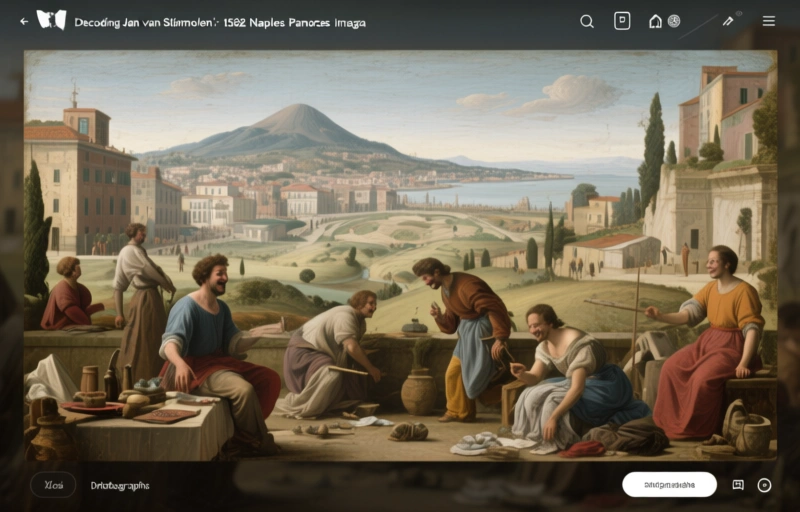
Discover how new research reveals Jan van Stinemolen's 1582 Panorama of Naples is a complex artistic construction, not a simple snapshot. Learn about the collaborative project that decoded its secrets.
If you're like me, you've probably seen old maps and drawings and thought they were just simple records of a place. A snapshot in time, right? Well, Jan van Stinemolen's *Panorama of Naples* from 1582 is anything but simple. It's a masterpiece that's been puzzling historians and art professionals for years. This wasn't just a guy sketching what he saw out his window. This was a deliberate, complex artistic construction.
I want to walk you through why this drawing is so special and what a recent collaborative research project uncovered. It's a fascinating story about how we interpret historical art, and it completely changes how we view this work.
### What Was the Research Project Really About?
The goal was pretty ambitious from the start. The team had two main objectives. First, they wanted to identify as many real-life locations in Stinemolen's drawing as possible. That's harder than it sounds when you're dealing with a cityscape from over 440 years ago. Second, they dove deep into the artistic composition itself. They asked: how was this put together? What techniques did he use? What was he trying to say beyond just showing Naples?
What they found was incredible. This panorama is an intermedial construction. That's a fancy term meaning it blends different artistic mediums and perspectives. It's part map, part landscape painting, part architectural study. Stinemolen wasn't just copying reality; he was interpreting it, shaping it, and presenting a specific vision.
### The Tools That Made It Possible
This research didn't happen in a vacuum. A key resource was the collection of digitized maps held at the Bibliotheca Hertziana – Max Planck Institute for Art History. Think of these as the historical GPS for the project. By carefully annotating and comparing these old maps with the panorama, researchers could start to piece the puzzle together.
- They cross-referenced street layouts and building footprints.
- They analyzed the perspective and sightlines Stinemolen used.
- They identified landmarks that have since changed or disappeared.
This meticulous work was fundamental. It provided the concrete geographical foundation that all the artistic analysis was built upon. Without it, they'd just be making educated guesses.
### Why This Changes Everything
Here's the big takeaway: the *Panorama of Naples* is not a photograph. It's not even a straightforward drawing from life. The investigation revealed it's a carefully composed piece of propaganda, artistry, and technical skill. Stinemolen made choices—what to include, what to emphasize, what viewpoint to use. These choices tell us about power, perception, and how the city wanted to be seen in the late 16th century.
As one researcher noted, "The work reveals a narrative about the city's grandeur, far beyond topographical accuracy."
This shifts the entire conversation. We're no longer just looking at an old picture of Naples. We're decoding a message. We're understanding the artistic conventions of the time. We're seeing how an artist could use a panorama to tell a story about civic pride, political power, and cultural identity. For professionals studying this period, that's a goldmine. It opens up new questions about other similar works and how we catalog and interpret historical imagery in our digital age. The project's essential bibliography, which expands on these interpretations, is now a crucial tool for anyone serious about Renaissance cartography and art. It pushes us to look deeper, to question the surface, and to appreciate the incredible complexity hidden in what might first appear to be a simple view of a city.