Art & Ideology: How Science United Opposing Visions
Miguel Fernández ·
Listen to this article~4 min
Explore how anarchist painter Paul Signac and decorator Henry Havard, despite opposing ideologies, both used scientific principles of color and form to shape their visions of society and the home.
Let's talk about something that might seem contradictory at first. Picture this: a radical anarchist painter and a mainstream interior design expert. They're coming from completely different worlds, right? One's trying to tear down the system, the other's helping people decorate their homes within it. Yet, in late 19th-century France, their paths crossed in the most fascinating way.
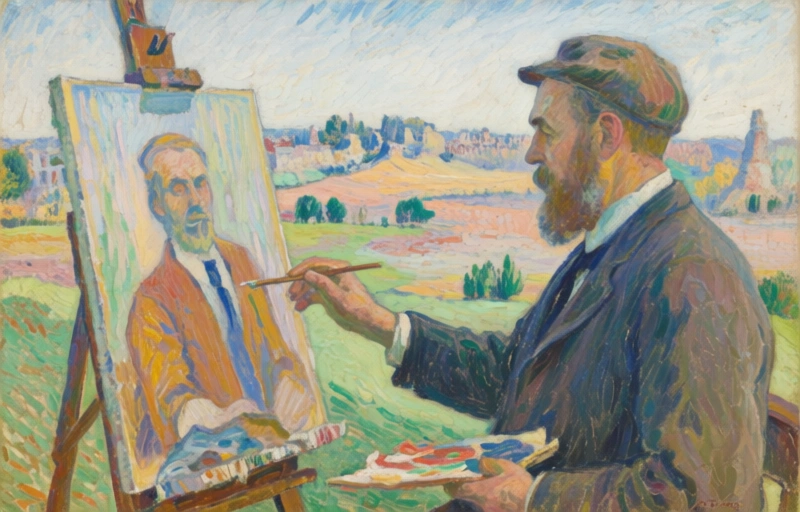
We're looking at Paul Signac, a key figure in the Neo-Impressionist movement. His paintings of bourgeois interiors, like *Salle à manger* (1886–1887) and *Un Dimanche* (1888–1890), are more than just pretty pictures. They're loaded with his anarchist beliefs, a critique of the very society that created those comfortable rooms.
On the other side, you've got Henry Havard. He was the authority on home decor, publishing books like *L'Art dans la maison* (1884) and *La Décoration* (1892). His work was all about guiding the emerging consumer class—telling them what to buy, how to arrange it, how to live. It was the handbook for a new kind of bourgeois life.
### Where Opposites Found Common Ground
So, how do these two connect? It wasn't in their goals. Signac wanted to use art to challenge and change society from its roots. Havard wanted to help people build beautiful, fashionable homes within that society. Their ideologies were miles apart.
But here's the twist. They both turned to the same source for a fundamental part of their work: science. Specifically, the science of perception, color, and form. In an age obsessed with progress, both the anarchist and the decorator believed that rational, scientific principles could create something better.
You can see this shared language clearly in two areas:
- **The arrangement of space and furniture.** Both were concerned with how objects relate to each other and to the person in the room.
- **The psychology of color and line.** This is where it gets really interesting. They both believed that specific colors and shapes could influence mood and emotion.
Think about that for a second. An anarchist and a style guide writer both worrying about whether a curved line or a straight one, a warm red or a cool blue, would affect your state of mind. It's a strange and wonderful meeting point.
### The Shared Confidence in Progress
What truly linked Signac and Havard was a faith—a faith that through method, study, and scientific understanding, they could improve the human experience. For Signac, that meant a better, freer society. For Havard, it meant a more beautiful and harmonious home. Different destinations, but a surprisingly similar map.
This shared foundation led to striking visual similarities. The balance in a Signac painting isn't just artistic; it's almost mathematical. The advice in a Havard book isn't just about taste; it's presented as a logical system. They were both, in their own ways, trying to create order and meaning through a set of rules they believed were objectively true.
It makes you wonder, doesn't it? How often do we assume people on opposite sides of an idea have nothing in common? This story shows that sometimes, the most divergent paths are built on the same ground. They both looked at the chaos of the world—one political, one domestic—and believed that with the right tools, they could make sense of it.
That confidence in science as a unifying force is perhaps their most lasting legacy. It's a reminder that even when we disagree on the 'why' and the 'what for,' we can sometimes agree on the 'how.' And in that 'how,' we might just find a unexpected connection.